

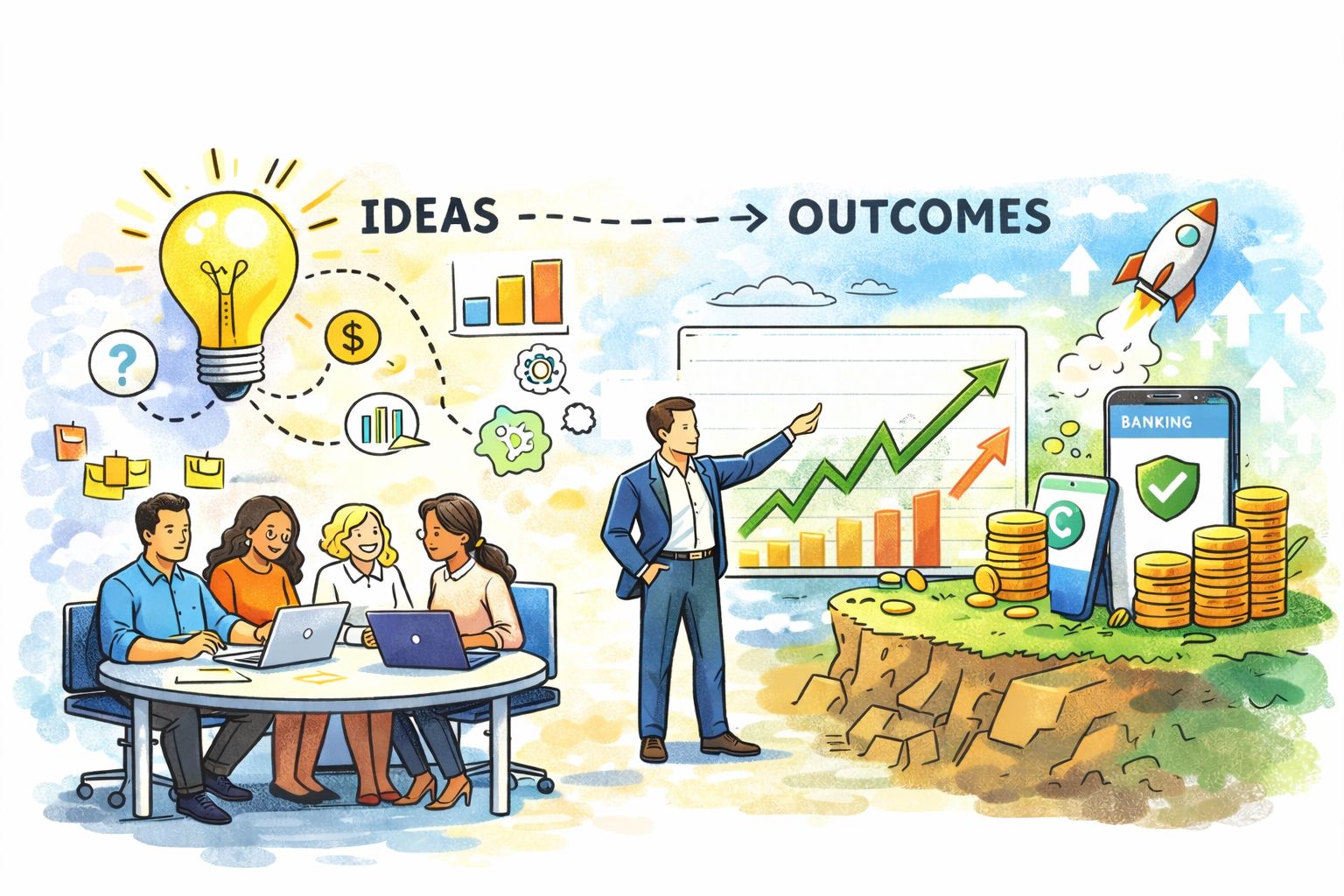
From Ideas to Outcomes How High-Performing Product Teams Actually Work in Fintech Every fintech company has ideas. Very few turn them into outcomes. The difference isn’t creativity. It’s how teams move from intent to impact.
From Ideas to Outcomes
How High-Performing Product Teams Actually Work in Fintech
Every fintech company has ideas.
Very few turn them into outcomes.
The difference isn’t creativity.
It’s how teams move from intent to impact.
Why Fintech Product Teams Struggle More Than They Expect
Fintech product teams operate under unique pressure:
Regulatory constraints
Complex money movement
Multiple stakeholders with conflicting incentives
Legacy systems beneath modern UX
This creates a dangerous illusion:
“Progress equals shipping.”
In reality, fintech rewards alignment, not speed.
The Idea Trap: When Discovery Never Ends
Some teams stay stuck in discovery:
Endless user interviews
Constant roadmap reshuffling
Fear of committing to a direction
Others skip discovery entirely:
“We already know what to build”
Heavy reliance on sales feedback
Reactive execution
High-performing teams balance both — with intent.
What Actually Moves the Needle
Across successful fintech products, a few patterns repeat.
1. Clear Problem Framing Beats Detailed Solutions
Strong teams articulate:
Who the user is
What pain they are solving
Why it matters now
Before a single screen is designed.
2. Strategy Is a Set of Explicit Trade-offs
Every roadmap is a bet:
Speed vs control
Flexibility vs simplicity
Customization vs scale
High-performing teams name these trade-offs early, instead of rediscovering them in production.
3. Validation Is Continuous, Not a Phase
Validation isn’t a workshop.
It’s embedded in:
Pilot releases
Partner feedback loops
Real usage data
The goal isn’t confidence.
It’s learning velocity.
4. Execution Is Ruthlessly Outcome-Driven
Great teams don’t celebrate features shipped.
They track:
Adoption
Revenue impact
Operational cost
Support burden
If outcomes don’t move, the work isn’t done.
The Role of Senior Product Leadership
Senior product leadership doesn’t replace teams — it amplifies them.
It helps teams:
Cut through ambiguity faster
Align engineering, business, and compliance
Make fewer but better decisions
Build systems that scale beyond one customer
Most importantly, it raises the quality of decisions, not just the quantity.
Why This Matters More in Fintech Than Anywhere Else
In fintech, bad product decisions linger:
In ledgers
In contracts
In partner agreements
In regulatory exposure
Undoing them later is expensive.
Strong product leadership early is cheaper than refactoring the business later.