

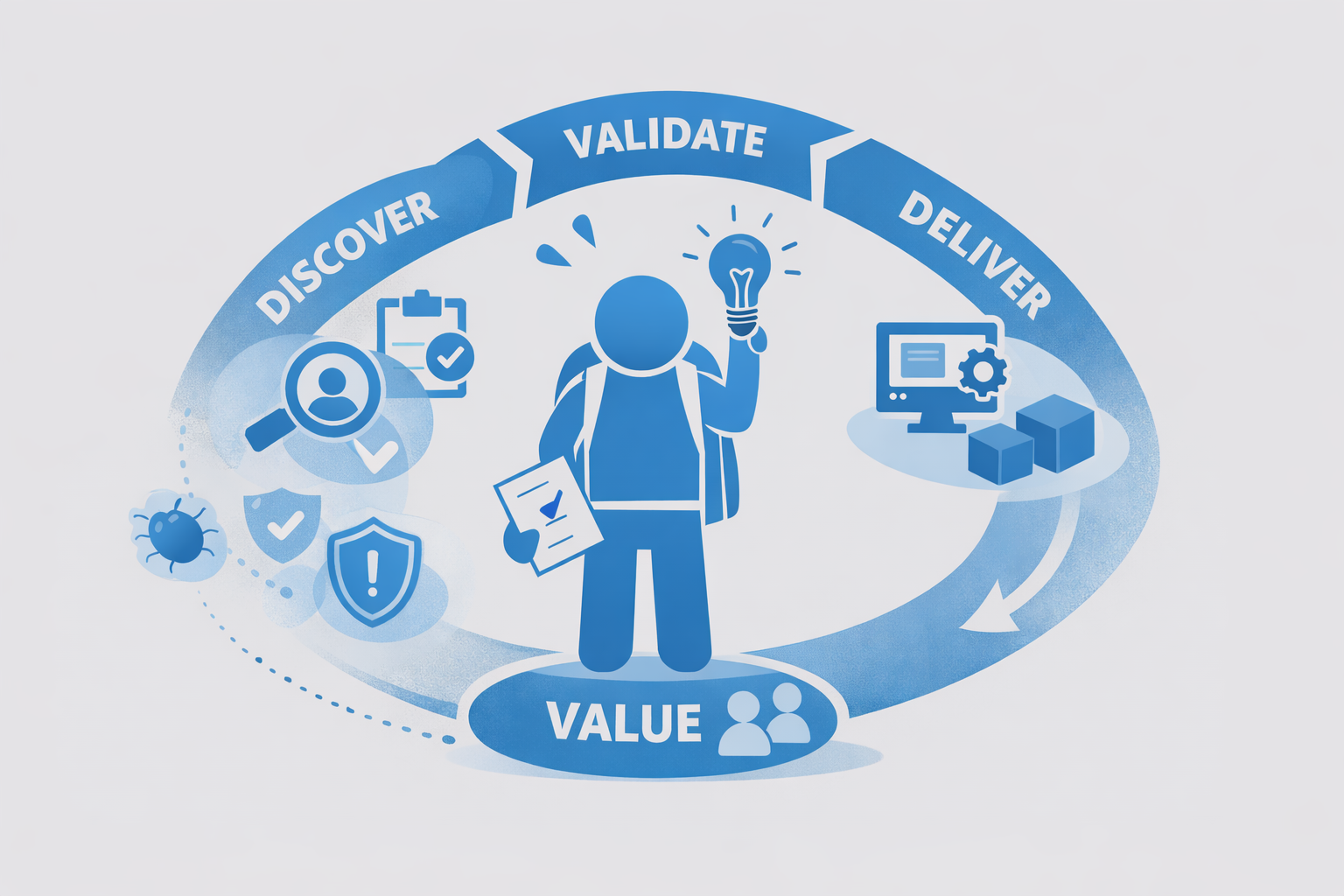
A deep dive into fintech product discovery—how strong teams reduce regulatory, usability, and value risk before writing code.
In Fintech, Every Feature Is a Risk Multiplier
Every new fintech feature introduces risk:
financial risk
regulatory risk
trust risk
operational risk
Code doesn’t create risk.
Unvalidated assumptions do.
Product discovery exists for one reason:
To reduce risk before it becomes expensive.
Discovery Is Not About Ideas
Ideas are abundant.
Good bets are rare.
Discovery is not brainstorming.
It’s structured risk reduction.
Before writing code, teams must answer:
Does this solve a real problem?
Will users change behavior?
Can this be delivered safely and legally?
Is this worth delaying other bets?
If discovery doesn’t answer these, it’s not discovery.
The Four Risks Fintech Discovery Must Kill
1. Value Risk
Do users actually care enough to act?
In fintech, stated intent is unreliable.
Only behavior matters.
Strong discovery tests:
willingness to switch
tolerance for friction
sensitivity to trust and risk
2. Usability Risk
Can users use this correctly?
Mistakes in fintech aren’t harmless.
They cost money and trust.
Validation must test:
comprehension
error recovery
edge cases
3. Feasibility Risk
Can this be built within real constraints?
Legacy systems, partner dependencies, and scale matter.
Discovery must involve engineering early — not after approval.
4. Compliance Risk
Can this exist legally and sustainably?
Compliance should be part of discovery, not a post-design blocker.
Why Fintech Discovery Must Be Continuous
Markets shift.
Regulations evolve.
User behavior changes under pressure.
Discovery that ends after MVP becomes outdated quickly.
High-performing fintech teams:
validate assumptions weekly
run small experiments continuously
adapt strategy based on evidence
They don’t “pause discovery” to deliver.
They discover through delivery.
Discovery vs Delivery Is a False Choice
Weak teams argue:
“We don’t have time for discovery.”
Strong teams respond:
“We can’t afford not to.”
Discovery without delivery is waste.
Delivery without discovery is risk.
The best teams design tight loops:
idea → test → learn → build → measure → refine
The loop never closes.
That’s the advantage.
What Leaders Must Do Differently
To make discovery real, leaders must:
reward learning, not certainty
accept that some ideas will die
protect teams from premature commitments
review evidence, not opinions
Discovery only works when leadership allows ideas to fail safely.
The Payoff: Fewer Surprises, Better Bets
When discovery is done well:
roadmaps stabilize
delivery accelerates
confidence increases
surprises decrease
Not because teams guess better —
but because they learn faster.
That’s how fintech products scale responsibly.