

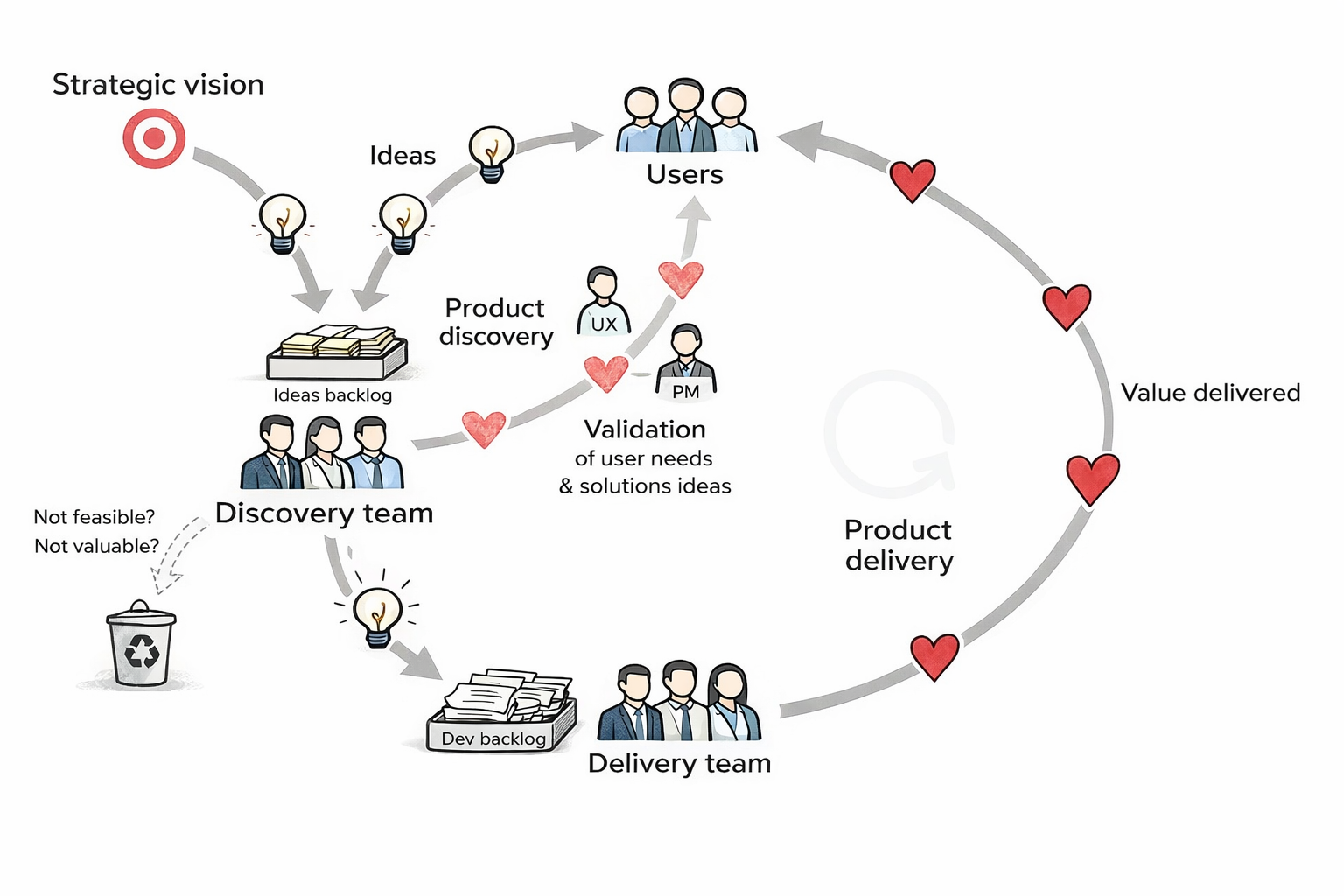
Product success isn’t linear. Ideas are tested, assumptions are validated, and value is delivered through a continuous discovery–delivery loop.
Most product teams say they “do discovery.”
What they really mean is:
a few user interviews at the start
a backlog grooming session
then straight into delivery mode for months
This diagram tells a different story.
A harder story.
And a more honest one.
Strategy Doesn’t Hand Down Solutions. It Sets Direction.
Everything starts with strategic vision — but strategy should never dictate features.
Strong strategy answers only three things:
Who are we building for?
What problem space matters most right now?
What outcomes define success?
Ideas flow from strategy, but ideas are disposable.
Strategy is not.
That’s why ideas fan out, not funnel down.
Ideas Are Cheap. Filtering Is the Real Work.
Notice how many ideas enter the system.
And how many quietly die.
This is intentional.
High-performing teams:
generate many ideas
expect most to be wrong
kill them early, cheaply, and without emotion
The ideas backlog is not a commitment.
It’s a parking lot.
If an idea isn’t:
feasible
valuable
or testable
It belongs in the bin — not in Jira.
Discovery Teams Exist to Say “No” Early
Discovery is not brainstorming.
It’s risk reduction.
The discovery team’s job is to answer:
Do users actually have this problem?
Will they change behavior to solve it?
Is this worth engineering effort now?
UX and PM don’t validate opinions.
They validate assumptions.
That’s why validation sits between ideas and delivery — not after launch.
Validation Is About Learning, Not Approval
Validation isn’t a gate.
It’s a feedback loop.
Good validation:
creates evidence, not confidence theater
informs scope, sequencing, and trade-offs
feeds directly back into discovery
Bad validation:
seeks stakeholder buy-in
cherry-picks user quotes
rubber-stamps pre-decided solutions
If validation doesn’t change the roadmap sometimes, it’s not working.
Delivery Is Where Value Is Earned — Not Declared
Shipping is not success.
Value is.
Delivery teams turn validated intent into reality:
reliable execution
clear ownership
predictable outcomes
The hearts around delivery in this visual aren’t sentiment.
They represent earned trust — from users, stakeholders, and the business.
Trust only comes when:
promises are kept
learning continues post-launch
feedback loops stay open
The Loop Is the Point
The most important thing in this image is the shape.
It’s a circle, not a funnel.
Users aren’t the end.
They’re the signal.
Value delivered flows back into:
strategy refinement
better ideas
sharper discovery
This is how product teams avoid:
building the wrong thing well
scaling the wrong roadmap
mistaking motion for progress
Why This Matters More in Fintech
In fintech, mistakes are expensive:
regulatory constraints
real money
real trust
long recovery cycles
You can’t afford linear thinking.
Teams that win in fintech don’t move faster.
They learn faster — and kill bad bets sooner.
That’s what this loop represents.
Not process.
Not frameworks.
Not buzzwords.
Just disciplined learning, repeated relentlessly.