

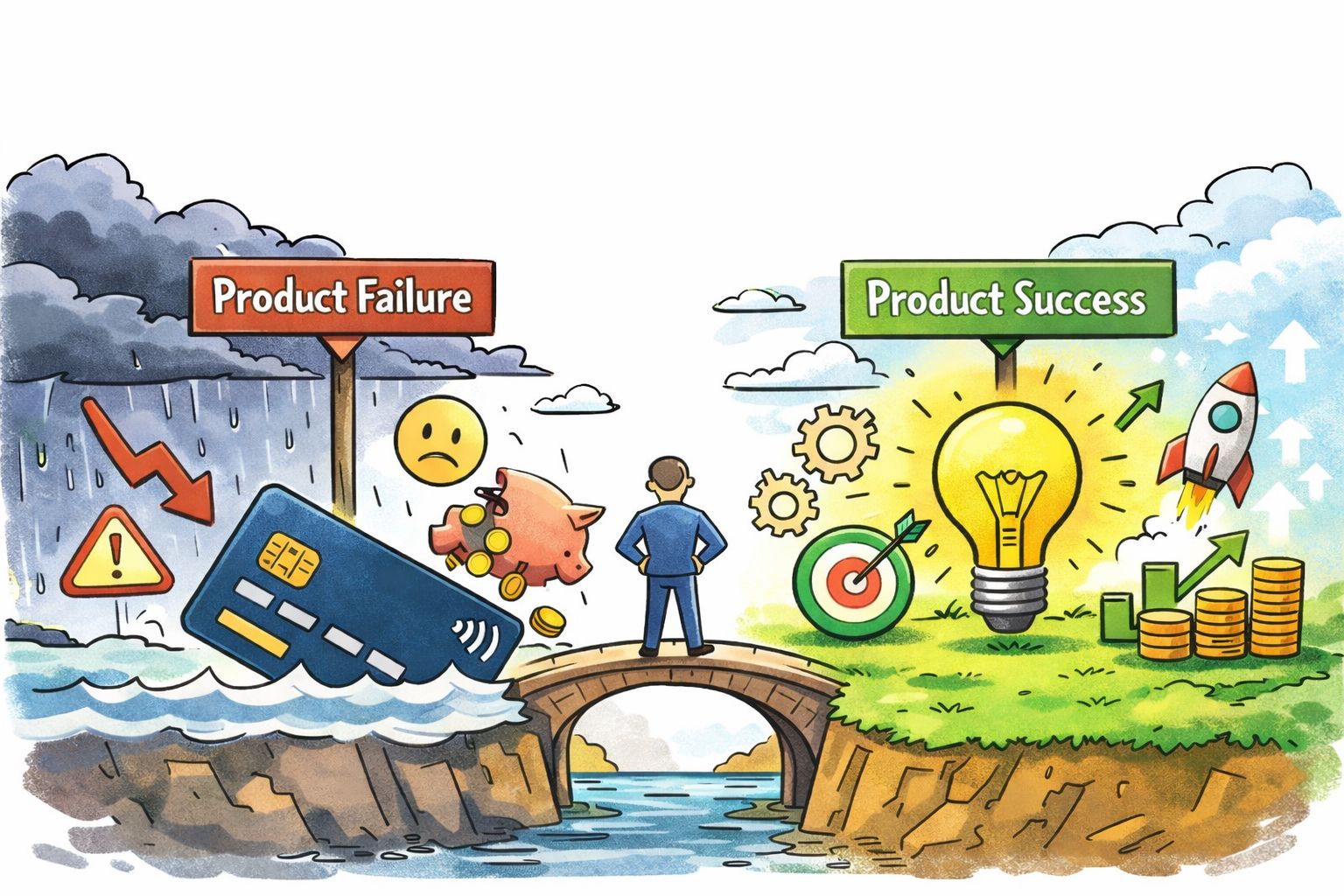
Most fintech products don’t fail with drama. No big shutdown. No public post-mortem. They fail quietly. The roadmap keeps moving. Features keep shipping. Engineers stay busy. But revenue stalls, customers churn slowly, and “just one more quarter” becomes the strategy. The problem usually isn’t technology. It’s not even market timing. It’s weak product leadership at the moments that matter
Why Fintech Products Fail Quietly
And What Strong Product Leadership Actually Fixes
Most fintech products don’t fail with drama.
No big shutdown. No public post-mortem.
They fail quietly.
The roadmap keeps moving.
Features keep shipping.
Engineers stay busy.
But revenue stalls, customers churn slowly, and “just one more quarter” becomes the strategy.
The problem usually isn’t technology.
It’s not even market timing.
It’s weak product leadership at the moments that matter.
The Silent Failure Pattern We See Repeatedly
Across fintech startups — payments, lending, banking, compliance tooling — the pattern is familiar:
The product started with a clear pain point
Early customers validated the idea
Growth introduced complexity: pricing, partners, regulations, edge cases
Decision-making slowed down
The roadmap became a negotiation, not a strategy
Teams stopped asking “should we build this?”
and only asked “how fast can we build it?”
That’s when products drift.
Fintech Is Unforgiving to Vague Decisions
Fintech compounds small product mistakes faster than most industries:
A pricing decision affects margins, partner splits, and compliance
A workflow shortcut creates downstream reconciliation nightmares
A vague requirement turns into months of operational workarounds
Without strong product leadership, teams default to:
Shipping for the loudest stakeholder
Over-customizing for one large client
Patching instead of designing
Individually, these choices feel rational.
Collectively, they erode the product.
What Strong Product Leadership Actually Does
(Beyond Roadmaps)
Good product leadership isn’t about Jira hygiene or prettier decks.
At a senior level, it does four uncomfortable things — consistently:
1. Creates clarity when data is incomplete
Fintech decisions are rarely obvious. Strong leaders synthesize signals instead of waiting for certainty.
2. Protects the product from short-term revenue traps
Not every enterprise request should become a permanent feature.
3. Connects business mechanics to product design
Pricing, settlement, risk, and operations are product decisions, not afterthoughts.
4. Builds momentum, not dependency
Teams move faster when decisions are clear — even if they’re imperfect.
Why Fractional Leadership Works Especially Well in Fintech
Hiring a full-time senior product leader is expensive and slow.
Waiting usually costs more.
Fractional product leadership works because it:
Brings pattern recognition from similar systems
Cuts through internal politics quickly
Focuses on outcomes, not org design
Leaves behind structure, not reliance
The goal isn’t to “run product forever.”
It’s to stabilize, clarify, and accelerate — then hand off cleanly.
The Real Cost of Waiting
By the time fintech founders say “we need stronger product leadership,” they’re usually already paying for it:
Delayed launches
Margin leakage
Frustrated engineers
Lost trust with partners
Strong product leadership doesn’t guarantee success.
But weak product leadership almost guarantees slow failure.